Part 4 – Summary
Corporate governance practices
Governing body
AFMA’s domestic fisheries management functions and powers are the responsibility of the AFMA Commission. AFMA’s Chief Executive Officer, who is also an appointed Commissioner, is responsible for assisting the Commission by giving effect to its decisions.
The Chief Executive Officer is separately responsible for exercising AFMA’s foreign compliance functions and powers and also has responsibilities as the Accountable Authority under the Public Governance, Performance and Accountability Act 2013 and Public Service Act 1999.
The Minister for Agriculture and Water Resources appoints the chairman, the other part-time commissioners and the Chief Executive Officer. Following advice from the chairman, the minister appoints a part-time commissioner as deputy-chairperson.
The Commission is subject to limited government direction under section 91 of the Fisheries Administration Act 1991. All Fishery Management Plans are determined by AFMA.
The Chief Executive Officer is subject to ministerial direction with regard to AFMA’s foreign compliance functions, and under the Public Service Act 1999, is required to be responsive to government in implementing the government’s policies and programs.
For more information about our commissioners, see Appendix 1 to this report.
Disclosure of interests
Commissioners must disclose to the Minister for Agriculture and Water Resources any pecuniary or other interest that may relate to their AFMA functions, both prior to appointment and if such interests arise during their terms of office. Disclosures of interests are kept on a register of interests held by AFMA. Where a commissioner declares they have an interest in a matter for consideration by the Commission it will initiate a procedure to determine the action required to safeguard the integrity of the Commission’s decisions.
Performance review
The Commission reviews its performance at each Commission meeting. Matters reviewed address the effectiveness of the Commission in its decision making, corporate governance and maintenance of stakeholder relationships.
Internal scrutiny
Internal audits are an essential tool for us to independently identify deficiencies and provide opportunities to deliver better practices that will improve the efficiency, cost effectiveness and transparency of our management and regulatory arrangements.
To this end we engage the services of an independent internal auditor to review financial and non-financial policies and operations. This ensures AFMA’s financial and operational controls are operating in an efficient, effective, economical and ethical manner. Such reviews also assist AFMA management to improve business performance.
During 2015–16, all three of the planned audits from the internal audit plan were completed as follows:
- stakeholder engagement
- contract procurement and review
- compliance with the Public Governance, Performance and Accountability Act 2013.
As a result of these audits we:
- have increased resources to more effectively engage with stakeholders
- have reviewed and updated our communication strategy and are developing a social media strategy to be more effective in engaging with our stakeholders as well as providing media awareness training for staff
- have provided a suite of procurement and contract management guidance to staff and conducted related training for staff
- have upgraded our internal systems to capture and report on contract procurements
- are updating our fraud control plan to ensure our approach to managing incidents is defensible, effective and compliant with government policy
- have improved our guidance and training for staff on the requirements of the Public Governance, Performance and Accountability Act 2013
- have developed performance indicators and measurements for 2015–16 and established templates for their collection. Associated standard operating procedures will be prepared to support the development and collection of future performance measures.
In addition we have established a number of standing committees which provide oversight and governance over key operational activities. These committees include the Project Governance Committee and the Information Governance Committee. The Chief Executive Officer has maintained the Audit and Risk Committee to also provide internal scrutiny of AFMA operations. Descriptions of these committees are provided in Appendix 1.
External scrutiny
Our financial statements are audited annually by the Australian National Audit Office (the Audit Office). The Audit Office examines the strength of our internal controls to obtain reasonable assurance about whether the annual financial statements as a whole are free from material misstatement. The results of their audit are presented in their report on the financial statements in Part 5 of this report.
The Audit Office obtains and updates its understanding of AFMA, the environment in which we operate, our objectives and strategies and internal controls. This includes gaining an understanding of the information systems and related business processes relevant to our financial reporting objectives (including the accounting system) and how we have responded to any related financial reporting risks. Relevant Audit Office performance audits or internal audit activity are considered as part of this process.
Our performance is subject to review through Senate Estimates. Parliament may also review and disallow legislative instruments proposed by AFMA as part of its delegated functions.
Outcomes of judicial and administrative tribunals are referenced at Appendix 2: ‘Civil Litigation Outcomes’.
AFMA made a submission to the Productivity Commission’s inquiry on Marine Fisheries and Aquaculture, which is looking at ways to improve the regulation of Australia’s marine fisheries so as to enhance their productivity. The Productivity Commission is scheduled to table its final report in December 2016.
Corporate planning and reporting
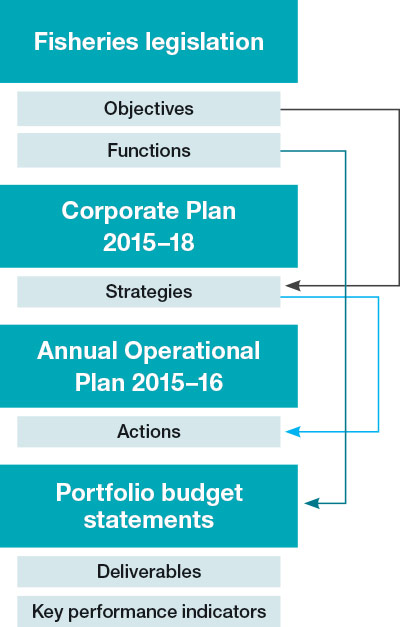
AFMA’s planning and reporting framework consists of obligations under the Fisheries Administration Act 1991, whole-of-government requirements under the Public Governance, Performance and Accountability Act 2013 and Public Governance, Performance and Accountability Rule 2014 and internal documents we produce for the purpose of good governance. The key elements are described below.
Portfolio budget statements
AFMA contributes to the Department of Agriculture and Water Resource’s Portfolio Budget Statements. The purpose of the Portfolio Budget Statements is to inform parliament of the proposed allocation of resources to achieve government outcomes. Within this document, we set out our broad strategic direction, budget estimates against specific outputs, and key performance indicators.
Corporate plan
This plan identifies factors in AFMA’s operating environment that may affect our operations and sets out our principal goals for the next four years. We have reported against the key result areas identified in our Corporate Plan 2015–18 in Part 2 (the Annual Performance Statement) of this report.
Annual operational plan
This plan details particular activities and actions that we intend to take during the year in order to further the goals set out in the corporate plan.
Internal reporting
Each quarter, we report to our Chief Executive Officer and the Commission against our goals and strategies, key result areas and key performance indicators identified in our annual operational plan. This ensures that progress is monitored and actions are taken to rectify underperformance throughout the financial year.
Section plans
Every business unit within AFMA is required to develop section plans. These plans ensure that our business activity across the agency is both coordinated and focused on delivering directly to the objectives identified in our annual operational plan. These plans form the basis of allocating our resources to the various business activities and/or specific projects that directly support the outcomes of the annual operational plan. Section plans also inform individual staff performance plans against which our staff are assessed throughout the reporting period.
Risk Management
AFMA’s corporate risk management procedures have been in place since 2008 and necessary processes are embedded in our planning, project management and fraud control procedures. AFMA’s risk management framework and risk register are regularly reviewed, and in 2015 a comprehensive review of our overall risk management practices was undertaken.
The review found that while we have robust risk management processes in place, the introduction of the Public Governance, Performance and Accountability Act 2013 and the Commonwealth Risk Management Policy had resulted in some of these processes becoming redundant. The Audit and Risk Committee considered a new risk management policy and risk management framework.
The new policy alters the focus of AFMA’s risk management to a more streamlined ‘what must go right’ philosophy. This will make risk management more tangible to our staff and provide clearer oversight for the Executive. Staff at all levels are responsible for participating in the risk management process through staff-directed risk assessments across the agency.
An appointed Risk Manager oversights the risk management process and it is monitored by AFMA’s Risk Management Committee and our Audit and Risk Committee. AFMA Commission meetings consider significant and current issues that potentially affect our operations or reputation and advice from the Audit and Risk Committee.
Business continuity
AFMA’s business continuity plan identifies essential business activities and provides guidance in establishing alternative arrangements in the event of unexpected disruption to normal service delivery. The plan enables the priority allocation of resources to critical business processes to ensure that we continue to function effectively following a disaster. The plan includes cyclone response procedures for our Darwin and Thursday Island offices, information and communications technology disaster recovery and AFMA’s Pandemic Plan.
The business continuity plan was established in 2010 and is tested, reviewed and updated annually, and monitored by the Audit and Risk Committee. An incident at our Canberra office on 29 January 2016 in which paint solvent fumes polluted the air-conditioning system throughout the building, forcing staff to evacuate the premises, provided an opportunity to test preparedness. Assessment following this incident identified several areas for enhancement including the mobility of information and communications technology equipment, evacuation procedures and communications and availability of appropriate offsite work space.
Fraud control
As required under section 10 of the Public Governance, Performance and Accountability Rule 2014, we have prepared a fraud risk assessment and a fraud control plan, and have in place appropriate fraud prevention, detection, investigation and reporting mechanisms that meet the specific needs of AFMA. We have also engaged an external consultant to assist in the review of our fraud control, the drafting of a new fraud control plan for the period 2017–19, an update of the fraud risk assessment and the creation and delivery of a fraud awareness and education package for staff.
AFMA investigated 109 new external fraud related matters during 2015–16. These were primarily associated with breaches of the domestic quota management arrangements, failure to fit AFMA’s Vessel Monitoring System or have it operating at all times, unauthorised and unlicensed fishing, breaching management plan arrangements, fishing/navigating in closed areas and breaching trip species limits. An additional 25 external fraud matters were carried over from the previous year.
We finalised 109 external fraud matters as a result of instituting either administrative or prosecution action. There are still 25 matters currently under investigation, referred to the Commonwealth Director of Public Prosecutions, in court or otherwise in the process of finalisation.
Audit and Risk Committee
AFMA’s Audit and Risk Committee provides independent assurance and advice to the Chief Executive Officer and the AFMA Commission on AFMA’s financial reporting, performance monitoring, systems of risk oversight and management and systems of internal control.
For further information on the Audit and Risk Committee see Appendix 1.
Compliance with finance law
Under paragraph 19(1)(e) of the Public Governance, Performance and Accountability Act 2013 AFMA must include a statement in the annual report of any significant issues reported to the responsible minister that relate to non-compliance with the finance law in relation to the entity. If such a statement has been included in the annual report the Public Governance, Performance and Accountability Rule 2014 also requires the annual report to include an outline of the actions taken to remedy the non-compliance.
AFMA’s review of compliance for 2015–16 with finance law (the Public Governance, Performance and Accountability Act 2013 and associated rules and instruments) indicates that there are no significant matters that warrant reporting to the minister.
PURCHASING
There has been a concerted effort during the year to review and update AFMA’s policies and procedures for procurement and contract management to drive improved performance with respect to AFMA’s responsibilities under the Commonwealth Procurement Rules.
AFMA’s approach to procurement and contract management is based on a self-service model enabling staff at all levels within the organisation to undertake procurement and contract management activities within a clearly defined framework.
The relevant policies, procedures, tools and process maps are all easily accessible on AFMA’s intranet for staff to use. Importantly, a procurement and contract management training package has been developed and delivered across AFMA. To further support procurement and contract management capabilities within AFMA, a community of practice has been fostered so that experience can be shared across the organisation.
Contracts
Australian National Audit Office access clauses
All contracts valued at $100 000 or more (GST inclusive) let during the year allow the Auditor-General to have access to the contractor’s premises.
Exempt contracts
The Chief Executive Officer did not exempt any contracts let during 2015–16 from being published on AusTender on the basis that publication would disclose exempt matters under the Freedom of Information Act 1982.
Advertising campaigns
AFMA did not conduct any advertising campaigns during the year.
Discretionary grants
AFMA did not administer any grants during the year.
PEOPLE MANAGEMENT
Our staff
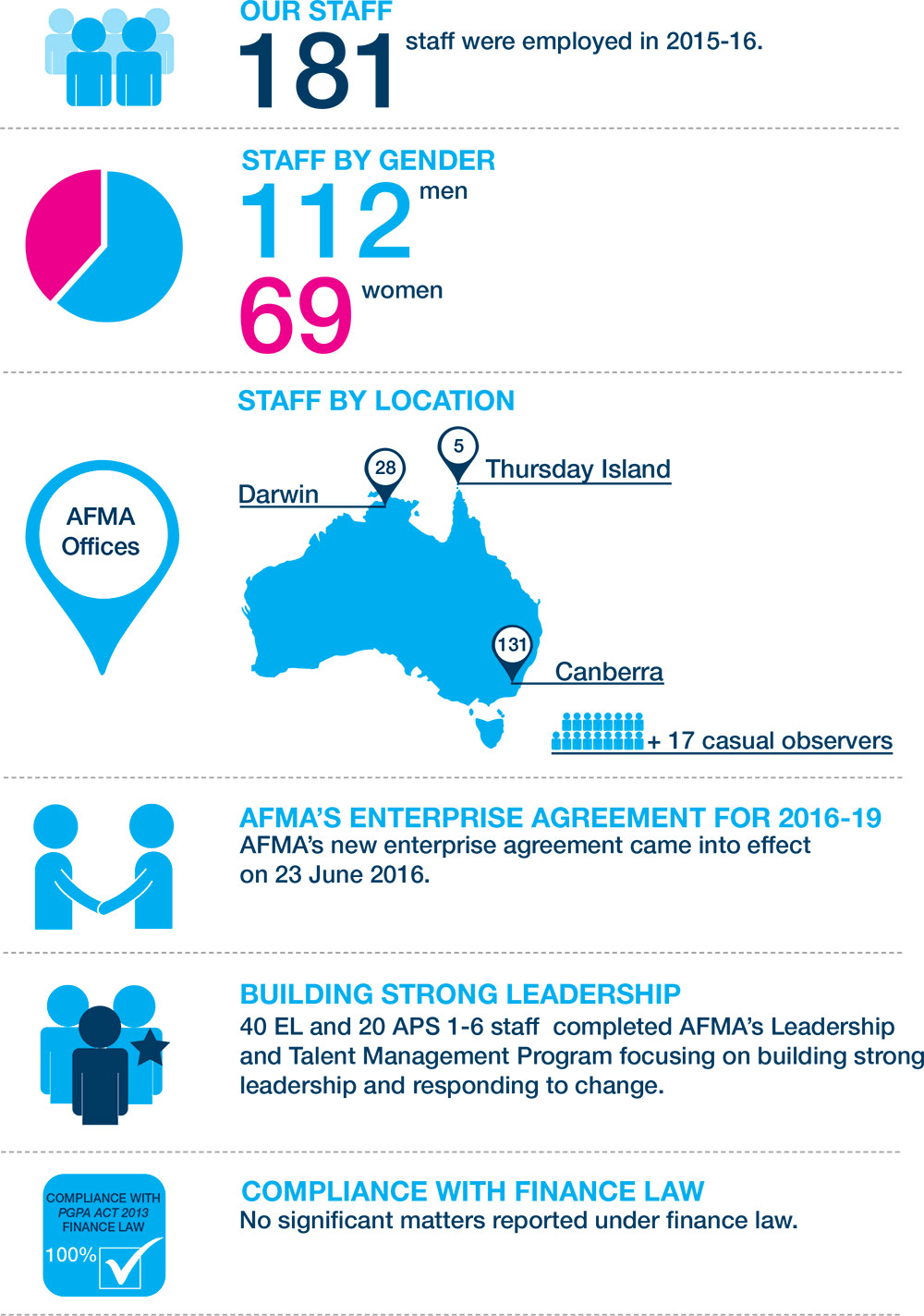
As at 30 June 2016, we employed 181 staff (based on head count): 157 were ongoing and 24 were non-ongoing. There were 131 staff located in our Canberra office, 28 staff located in our Darwin office and five staff on Thursday Island. A further 17 casual field observers undertake duties on commercial fishing vessels around Australia. These numbers do not include four employees on long-term leave or two employees on temporary transfer to other Australian Public Service agencies.
Our employment profile has not significantly changed from 2014–15. The proportion of part-time staff has decreased slightly to 11.6 per cent in 2015–16 compared to 12 per cent in 2014–15.
The proportion of females has increased to 38 per cent from 34 per cent in the previous financial year. The percentage of women at EL1–2 levels for 2015–16 has increased to 27 per cent from 25 per cent in the previous year.
There has been an increase in the number of staff from non-English speaking backgrounds with seven staff in 2015–16, up from four in 2014–15.
As a comparison with the 2014–15 financial year, the number of staff whose parents come from a non-English speaking background has increased from 24 to 29 with the number of staff members identifying as being Aboriginal or Torres Strait Islander decreasing from five employees to four. In addition, employees who identified themselves as having a disability decreased from four to one in 2015–16.
Equal opportunity profile of AFMA staff as at 30 June 2016
|
Level |
NESB1 |
NESB2 |
People with disability |
Aboriginal and Torres Strait Islander |
Women |
Men |
Total staff at level |
|
APS 2–4 |
1 |
10 |
0 |
4 |
21 |
32 |
53 |
|
APS 5–6 |
6 |
15 |
1 |
0 |
34 |
38 |
72 |
|
EL1 |
0 |
3 |
0 |
0 |
10 |
27 |
37 |
|
EL2 |
0 |
0 |
0 |
0 |
4 |
12 |
16 |
|
SES |
0 |
1 |
0 |
0 |
0 |
3 |
3 |
|
Total |
7 |
29 |
1 |
4 |
69 |
112 |
181 |
NESB1: Persons from a non-English speaking background who were born overseas.
NESB2: Persons whose parent/s is/are from a non-English speaking background.
Non-ongoing staff employed by location, gender and employment status as at 30 June 2016
|
Level |
Location |
Women |
Men |
Total staff at level |
||
|
Part time |
Full time |
Part time |
Full time |
|||
|
APS 1–2 |
Canberra |
0 |
0 |
12 |
0 |
12 |
|
Darwin |
0 |
0 |
0 |
0 |
0 |
|
|
Thursday Island |
1 |
0 |
0 |
0 |
1 |
|
|
APS 3–4 |
Canberra |
0 |
1 |
5 |
1 |
7 |
|
Darwin |
0 |
0 |
0 |
0 |
0 |
|
|
Thursday Island |
0 |
0 |
0 |
0 |
0 |
|
|
APS 5–6 |
Canberra |
0 |
1 |
0 |
0 |
1 |
|
Darwin |
0 |
0 |
0 |
0 |
0 |
|
|
Thursday Island |
0 |
0 |
0 |
0 |
0 |
|
|
EL1 |
Canberra |
0 |
1 |
0 |
1 |
2 |
|
Darwin |
0 |
0 |
0 |
0 |
0 |
|
|
Thursday Island |
0 |
0 |
0 |
0 |
0 |
|
|
EL2 |
Canberra |
0 |
0 |
0 |
1 |
1 |
|
Darwin |
0 |
0 |
0 |
0 |
0 |
|
|
Thursday Island |
0 |
0 |
0 |
0 |
0 |
|
|
SES |
Canberra |
0 |
0 |
0 |
0 |
0 |
|
Darwin |
0 |
0 |
0 |
0 |
0 |
|
|
Thursday Island |
0 |
0 |
0 |
0 |
0 |
|
|
Total |
1 |
3 |
17 |
3 |
24 |
|
* These figures include 17 observers who are engaged as APS 2/3 casual employees and are reported in the Canberra ‘part time’ figures.
Ongoing staff employed by location, gender and employment status as at 30 June 2016
|
Level |
Location |
Female |
Male |
Total staff at level |
||
|
Part time |
Full time |
Part time |
Full time |
|||
|
APS 1–2 |
Canberra |
1 |
1 |
0 |
1 |
3 |
|
Darwin |
1 |
0 |
0 |
0 |
1 |
|
|
Thursday Island |
0 |
0 |
0 |
0 |
0 |
|
|
APS 3–4 |
Canberra |
2 |
10 |
0 |
7 |
19 |
|
Darwin |
0 |
4 |
0 |
5 |
9 |
|
|
Thursday Island |
0 |
0 |
0 |
1 |
1 |
|
|
APS 5–6 |
Canberra |
11 |
19 |
0 |
27 |
57 |
|
Darwin |
0 |
3 |
0 |
10 |
13 |
|
|
Thursday Island |
0 |
0 |
0 |
1 |
1 |
|
|
EL1 |
Canberra |
4 |
5 |
1 |
21 |
31 |
|
Darwin |
0 |
0 |
0 |
3 |
3 |
|
|
Thursday Island |
0 |
0 |
0 |
1 |
1 |
|
|
EL2 |
Canberra |
0 |
3 |
0 |
10 |
13 |
|
Darwin |
0 |
0 |
0 |
1 |
1 |
|
|
Thursday Island |
0 |
1 |
0 |
0 |
1 |
|
|
SES |
Canberra |
0 |
0 |
0 |
2 |
2 |
|
Darwin |
0 |
0 |
0 |
1 |
1 |
|
|
Thursday Island |
0 |
0 |
0 |
0 |
0 |
|
|
Total |
19 |
46 |
1 |
91 |
157 |
|
This table does not include four staff on long term leave or two AFMA employees on temporary transfer to other Australian Public Service agencies. These figures relate to the nominal occupants of the position and not employees who may be acting as at 30 June 2016. This SES figure also includes AFMA’s Chief Executive Officer.
Our human resource management
Australian Public Service Employee Census
In 2016 we again participated in the Australian Public Service Employee Census. The census allows AFMA to collect feedback, address specific issues and shape future priorities. This year saw staff participation exceeding the previous 2015 census with 79 per cent of our staff engaged in the process. This was above the average of the Australian Public Service which saw an overall participation rate of 69 per cent.
Results from the 2015 census (the latest available) indicated AFMA performed well against areas of agency engagement, learning and development and work-life balance. The results showed the majority of staff surveyed were proud to work for us.
While these were positive results, staff did indicate they would like to see improved internal communication, better change management and more opportunities for career progression. We have an ongoing commitment to improve in these areas and over the past 12 months we have made significant progress through the following initiatives:
- implementing an AFMA specific Leadership and Talent Management program focusing on building strong leadership and responding to change
- Chief Executive Officer meetings with APS 1–6 and EL1 staff and fortnightly managers meetings, which have significantly improved internal communication
- increasing staff awareness to utilise AFMA’s intranet as both a communication tool and a training and resource centre for staff.
AFMA rewards and recognition program
We recognise high performance by individual employees and teams. Our annual achievement awards are hosted by the Chief Executive Officer and are a formal way to celebrate outstanding contributions to AFMA and acknowledge employee performance. We recognise that building a culture that values its employees and recognises performance is critical to retaining the best people. The 2015 achievement awards were presented at an all staff meeting in December 2015. A total of 12 nominations were received with six individual and six team nominations.
The individual achievement recipient was Ms Danielle Kuhn. Ms Kuhn, AFMA’s Communications Manager, was recognised for her exceptional commitment to delivering effective communications for AFMA.
During 2015 Ms Kuhn demonstrated dedication to ensure that the AFMA brand was appropriately represented in the media. The brand had also been widely recognised both domestically and internationally.
The team award recipient was the National Surveillance and Response Team. This team demonstrated their high level of commitment to AFMA’s mission and purpose. The team’s successful interactions and negotiations with supporting agencies ensured AFMA’s efforts relating to the protection of fish stocks and marine resources were widely acknowledged and supported.
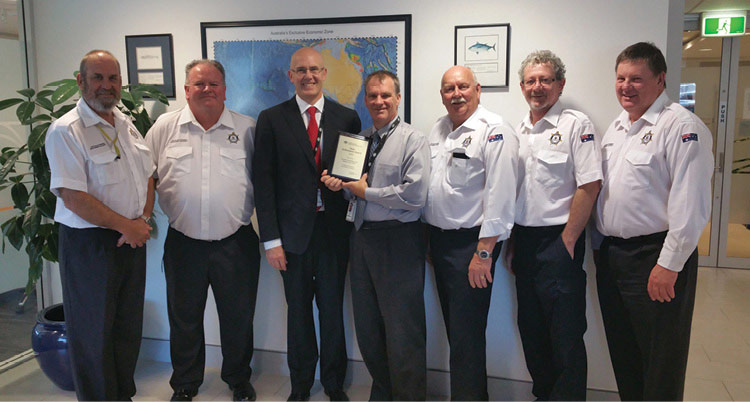
Figure 26: The National Surveillance and Response Team – From the left: A.Gerner, P.Spinney, J.Findlay (CEO), G.Salmon, A.Beckmann, D.Quinn, I.McNaughton.
Highly commended award recipients were Mr Andrew Trappett and the Demersal and Midwater Team.
The AFMA achievement awards are supported by our reward and recognition program. The program recognises individual and team achievements throughout the year and is determined by the Chief Executive Officer and branch heads on the recommendation of any member of staff. A total of 64 recognition awards were awarded across various branches and sections of AFMA.
Each year we offer staff the opportunity to nominate for the annual development award. The intention of the award is to recognise and reward performance on the part of the individual whilst providing an opportunity for personal development that ultimately benefits both the individual and AFMA. We awarded development awards which supported staff to attend the World Fisheries Congress (South Korea) and the Species on the Move International Conference (Hobart).
Performance management
All employees are required to participate in AFMA’s Performance and Development Scheme. This scheme provides a structured way for employees and managers to review performance and develop a future work program. The focus of the scheme is on development and support and, where necessary, management of underperformance.
We encourage employee participation in the performance management process. The Workplace Group (Human Resources) actively supports and assists employees and managers to resolve conflict and maintain productive working relationships.
.jpg)
Figure 27: Processing flathead – Photo courtesy of Mathew Daniels, AFMA.
Employment programs
This year we again partnered with the Department of Agriculture and Water Resources through the Graduate Development Program. AFMA engaged a graduate in 2015 who joined the Department of Agriculture and Water Resources graduate cohort by undertaking a combination of on-the-job-training, mentoring, a one week industry visit and a formal training program.
We also continued to focus on building a more diverse workforce and participated in the Australian Public Service Commission Pathways Program which resulted in AFMA welcoming an indigenous trainee in February 2016.
Stepping Into program
The ‘Stepping Into’ Program is an internship designed specifically for university students with a disability. We hosted one university student for paid work experience during the winter university break. The internship was undertaken within AFMA’s Policy, Environment, Economic and Research Section. The project involved researching AFMA’s historic databases to produce findings to inform the review of undercatch and overcatch components of AFMA’s quota management system.
The program is coordinated through the Australian Network on Disability and has been well received within AFMA.
Women in AFMA
We also continued our commitment to build and provide opportunities for women as future leaders within the agency. The Women in AFMA Group is championed and chaired by Dr Nick Rayns, Executive Manager Fisheries Management Branch and includes 13 members from a range of classification levels. In April 2016 the group organised an all staff event in recognition of International Women’s Day. The event welcomed Jo Schumann (Murray Darling Basin Authority) and Emily Canning (Department of Agriculture and Water Resources) who shared their stories and insights into having a successful and effective career in the Australian Public Service.
Australian National University Internships Program
The Australian National Internships Program gives undergraduate and postgraduate students an opportunity to work with Commonwealth agencies. During 2015–16, we hosted two students who contributed to the following projects:
- Assessing the trade-offs between protected species conservation and fisheries production. The project involved undertaking a literature review evaluating how fisheries can operate sustainably in an era of increasing public scrutiny and how society accepts the impacts of food harvesting.
- Stakeholder perspectives on the impacts of climate change on Commonwealth fisheries. The study was based on relevant literature and semi-structured interviews with stakeholders from a range of backgrounds. The study also covered the impact of climate change on fisheries management and adaptation of fisheries management to climate change.
Our terms and conditions of employment
AFMA’s Enterprise Agreement 2015–16
The conditions of employment for all AFMA staff, excluding Senior Executive Service officers, are covered by an enterprise agreement and associated policies.
AFMA continued negotiations for a new enterprise agreement during the financial year. A total of 19 meetings were held since negotiations commenced on 22 July 2014.
The Chief Executive Officer announced on 12 May 2016 that the proposed enterprise agreement was agreed by the majority of our staff who participated in voting (88 per cent). The percentage of staff who voted indicates significant engagement in the process by our staff with the number voting being one of the highest in AFMA’s history.
Following approval from the Fair Work Commission, the new enterprise agreement came into effect on 23 June 2016 and has a nominal expiry date of 22 June 2019. This agreement replaced AFMA’s Enterprise Agreement 2011.
AFMA’s Enterprise Agreement 2016–19 has a provision whereby the Chief Executive Officer and an employee covered by the agreement may enter into an individual flexibility arrangement to vary the effect of terms of the agreement.
AFMA entered into 42 individual flexibility agreements for 35 staff during 2015–16. The number of agreements is higher than the number of staff outlined in the table below. This is due to six staff having more than one agreement approved within the financial year. The details of the agreements made in 2015–16 are shown in the table below.
Individual flexibility agreements for 2015–16
|
Classification |
Number |
|
APS 1 |
0 |
|
APS 2 |
6 |
|
APS 3 |
0 |
|
APS 4 |
2 |
|
APS 5 |
5 |
|
APS 6 |
11 |
|
EL1 |
15 |
|
EL2 |
3 |
Remuneration
AFMA’s salary ranges are contained in AFMA’s Enterprise Agreement 2016. The salary minimum and maximum amounts at each classification as at 30 June 2016 are shown in the table below.
Enterprise agreement salary ranges as at 30 June 2016
|
Classification |
Minimum |
Maximum |
|
APS 1 |
$42 138 |
$49 244 |
|
APS 2 |
$52 794 |
$56 350 |
|
APS 3 |
$57 789 |
$62 805 |
|
APS 4 |
$65 313 |
$69 829 |
|
APS 5 |
$71 979 |
$76 236 |
|
APS 6 |
$80 490 |
$89 008 |
|
EL1 |
$99 014 |
$110 049 |
|
EL2 |
$116 164 |
$135 431 |
AFMA does not have performance bonuses.
AFMA’s salary ranges for Senior Executive Service staff (three) are contained in AFMA’s Executive Remuneration Policy. The salary range amounts as at 30 June 2016 are shown in the table below.
Salary ranges for Senior Executive Service staff
|
Classification |
Minimum |
Maximum |
|
SES Bands 1 and 2 |
$165 529 |
$232 529 |
The remuneration of senior executives is determined with reference to the remuneration survey published by the Australian Public Service Commission and is commensurate with the assessed complexity of their work. Senior executives are not eligible for a bonus amount after a performance assessment by the Chief Executive Officer. In addition to the salary ranges above, and as part of their total remuneration package, senior executive officers are also eligible to access other provisions including salary in lieu of a vehicle and car parking. Due to the small numbers of senior executives within AFMA, further breakdown of senior executive remuneration packages are not made available to avoid identification of individuals.
Remuneration for the Chief Executive Officer is determined by the Remuneration Tribunal. Details are available from the Remuneration Tribunal website.
AFMA did not make use of any non-salary benefits in 2015–16.
Training and development
In 2015–16 we continued to invest in the development of our staff, with an emphasis on strong leadership and talent management. A training plan was developed for the 2015–16 financial year taking into consideration staff capability plans and AFMA’s results from the 2015 Australian Public Service census. The training plan clearly articulated AFMA’s approach to learning and development and identified six capability development priorities – leadership, change management, resilience, negotiation and influencing, emotional intelligence and communication.
An AFMA Leadership and Talent Management Program was developed in conjunction with the Centre for Public Management and commenced in March 2016. The year’s program involved 40 Executive Level staff and 20 APS 1–6 staff. The program was specifically designed for us and focused on strengthening the capability and confidence of managers and developing future leaders. As part of the program, all participants took part in personal profiling. The Executive Level training program also included a formal 360 degree feedback component. The program saw a significant increase in the rate of employee participation and engagement in our learning and development activities. Participants have provided positive reviews, gaining insight and self-awareness. The program will continue to boost our leadership capability and become a platform for future talent development within AFMA.

Figure 28: Safety training, Jervis Bay – Photo courtesy of Rebecca Atkins, AFMA.
Study Assistance Program
We continue to support employees who choose to study at tertiary level to expand individual and organisation capabilities. The program assists employees to pursue studies that are directly related to AFMA’s business, including assistance in the form of funding and/or study leave. In 2015–16, seven employees were granted study assistance for studies in various areas including environmental science, communications, applied science (focusing on fisheries management) and bookkeeping qualifications.
Back to Top

